



P2Y Receptor
P2Y receptors are a class of G protein-coupled receptors (GPCRs) activated by extracellular nucleotides (ATP, UTP, and UDP). There are eight mammalian P2Y receptor subtypes (P2Y1, P2Y2, P2Y4, P2Y6, P2Y11, P2Y12, P2Y13, and P2Y14). The P2Y receptors are expressed in various cell types and play important roles in physiology and pathophysiology including inflammatory responses and neuropathic pain.
The P2Y family can be further divided into a subfamily of five P2Y1, P2Y2, P2Y4, P2Y6, and P2Y11Rs (“P2Y1-like”) that stimulate phospholipase C (PLC) through Gq protein and a second subfamily of P2Y12, P2Y13, and P2Y14Rs (“P2Y12-like”) that inhibit adenylate cyclase through Gi protein. Other effector pathways have been documented, such as coupling of the P2Y11R to Gs as well as to Gq in some cells to induce stimulation of cyclic AMP production.
P2Y Receptor Isoform Specific Products
All Product Categories
-
P2Y Receptor Inhibitors
(58)
View all products
-
P2Y Receptor Agonists
(50)
View all products
-
P2Y Receptor Antagonists
(85)
View all products
-
P2Y Receptor Activators
(11)
View all products
-
P2Y Receptor Modulators
(4)
View all products
-
P2Y Receptor Controls
(3)
View all products
-
P2Y Receptor Ligands
(3)
View all products
-
P2Y Receptor Related Products (229)
Related Products (229)

-
Antibodies (2)
-
P2Y Receptor Isoform Comparison
-
MRS2693 trisodium
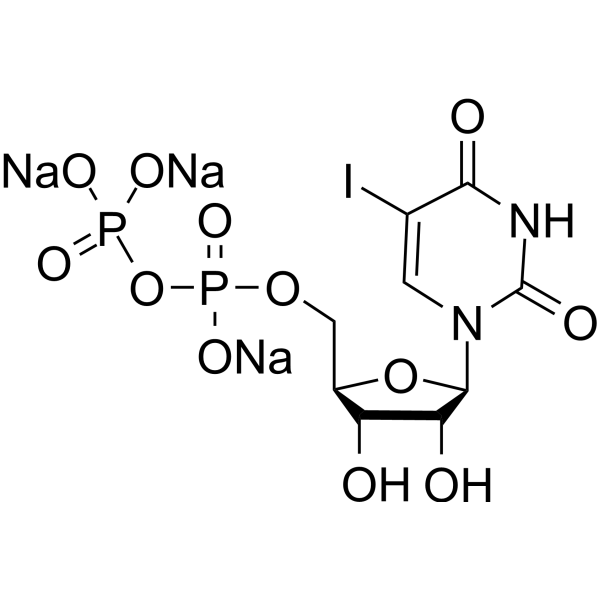 0 ImagesCat. No.: HY-117356BCAS No.: 1448858-83-0MRS2693 trisodium is a selective P2Y6 agonist with an EC50 value of 0.015 μM. MRS2693 trisodium can reduce the activation of NF-kappaB and activate the ERK1/2 pathway, and has a cytoprotective effect on mouse hindlimb skeletal muscle ischemia-reperfusion injury model.
-
Desmodilactone
 0 ImagesCat. No.: HY-N18260CAS No.: 60010-74-4Desmodilactone is a P2Y1R allosteric antagonist. Desmodilactone can be used for the research of thrombosis.
-
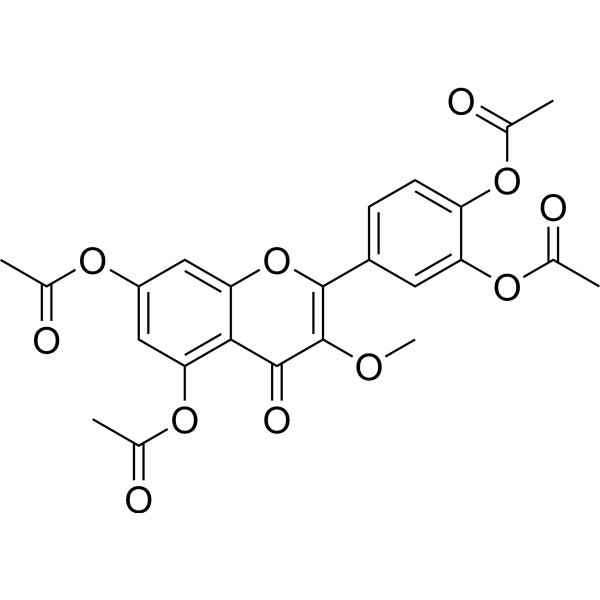
P2ry13 Rat Pre-designed siRNA Set A
 0 ImagesCat. No.: HY-RS09924
P2ry13 Rat Pre-designed siRNA Set A contains three designed siRNAs for P2ry13 gene (Rat), as well as a negative control, a positive control, and a FAM-labeled negative control.
-
ACT-281959
 0 ImagesCat. No.: HY-119085CAS No.: 1159501-31-1ACT-281959 is an orally active prodrug of Selatogrel (HY-109122), a P2Y12 receptor antagonist. ACT-281959 can inhibit platelet aggregation and can be used for the research of cardiovascular disease.
-
P2Y1 antagonist 1
 0 ImagesCat. No.: HY-120636CAS No.: 1555697-67-0P2Y1 antagonist 1 (compound 10q) is a potent antagonist of P2Y1, with the IC50s of 1.1 nM and 0.24 μM in FLIPR assay and hPA assay, respectively. P2Y1 antagonist 1 plays an important role in antiplatelet research.
-
Adenosine 3'-phosphate 5'-phosphosulfate
 0 ImagesAdenosine 3'-phosphate 5'-phosphosulfate, an adenine nucleotide derivative, is a selective P2Y1 antagonist with no effect on P2Y2, P2Y4, or P2Y6 receptors. Adenosine 3'-phosphate 5'-phosphosulfate can competitive inhibit ADP-induced platelet aggregation, as well as the ability of ADP to cause shape change and increases in Ca2+ in platelets, but had no effect on the inhibition of stimulated adenylate cyclase by ADP. Adenosine 3'-phosphate 5'-phosphosulfate is a co-substrate used for the sulfonation of glycans. Adenosine 3'-phosphate 5'-phosphosulfate can be used for Golgi-resident PAP-specific 3'-phosphatase-coupled sulfotransferase assays, which as donor substrate to transfer a sulfonate group.
-
Ap4C tetrasodium
 0 ImagesCat. No.: HY-134369CAS No.: 1352921-13-1Ap4C tetrasodium is a dinucleoside polyphosphate containing purine and pyrimidine base moieties. Ap4C tetrasodium acts as a signaling molecule by binding to specific P2Y receptors, activating P2Y2 and P2Y4 receptors in platelets, leading to platelet aggregation and other cellular responses. Ap4C tetrasodium can be used for research in inflammation and blood coagulation.
-
P2Y12 antagonist 1
 0 ImagesP2Y12 antagonist 1 (compound 26) is a P2Y12 receptor antagonist with a Ki of 3.13 μM. P2Y12 antagonist 1 can be used to inhibit platelet aggregation and is a potential antithrombotic agent.
-
Ticagrelor (Standard)
 0 ImagesSynonyms: AZD6140 (Standard); AR-C 126532XX (Standard)Ticagrelor (Standard) is the analytical standard of Ticagrelor. This product is intended for research and analytical applications. Ticagrelor (AZD6140) is a reversible oral P2Y12 receptor antagonist for the treatment of platelet aggregation.
-
MRS2603
 0 ImagesCat. No.: HY-123202CAS No.: 860623-35-4MRS2603 is a pyridoxal derivative. MRS2603 antagonized both P2Y1 and P2Y13 receptors.
-
Clopidogrel (Standard)
 0 ImagesSynonyms: Clopidogrelum (Standard)Clopidogrel (Standard) is the analytical standard of Clopidogrel. This product is intended for research and analytical applications. Clopidogrel is an orally active platelet inhibitor that targets P2Y12 receptor. Clopidogrel is used to inhibit blood clots in coronary artery disease, peripheral vascular disease, and cerebrovascular disease.
-
MRS2496
 0 ImagesCat. No.: HY-119145CAS No.: 491611-67-7MRS2496 is a selective P2Y1 receptor antagonist with an IC50 value of 1.5 μM, exhibiting antiplatelet aggregation activity. MRS2496 can be used in the research of antiplatelet aggregation and blood-related diseases.
-
(±)-Clopidogrel hydrochloride
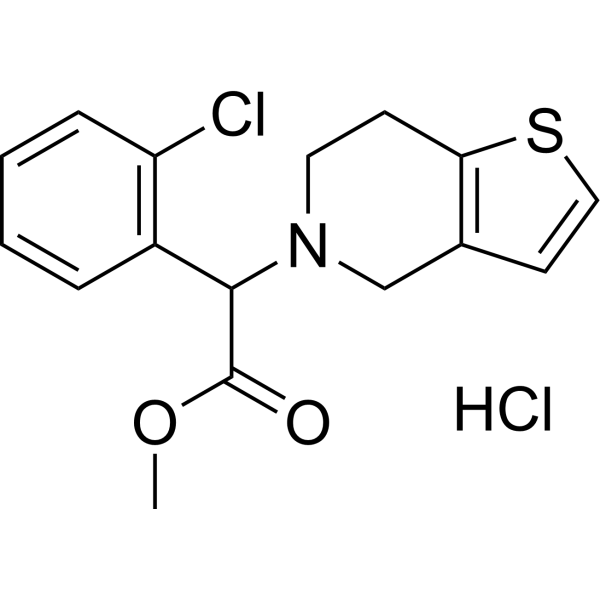 0 ImagesCat. No.: HY-110043CAS No.: 130209-90-4(±)-Clopidogrel hydrochloride is an antithrombotic agent that is ADP-selective and orally available. (±)-Clopidogrel hydrochloride inhibits platelet aggregation by inhibiting the binding of ADP to its platelet receptors.
-
Ticagrelor-d4
 0 ImagesCat. No.: HY-10064S1CAS No.: 1265911-54-3Synonyms: AZD6140-d4; AR-C 126532XX-d4Ticagrelor-d4 (AZD6140-d4) is deuterium labeled Ticagrelor. Ticagrelor (AZD6140) is a reversible oral P2Y12 receptor antagonist for the treatment of platelet aggregation.
-
(Rac)-BX 048
 0 ImagesCat. No.: HY-W419570CAS No.: 478005-11-7(Rac)-BX 048 is a BX 048 racemate. BX 048 is a P2Y12 receptor antagonist. BX 048 inhibits ADP-induced platelet aggregation in human, dog and rat whole blood. BX 048 also inhibits Arachidonic acid (HY-109590) induced platelet aggregation (IC50 of 15 μM).
-
ADP receptor-IN-1
 0 ImagesCat. No.: HY-11024CAS No.: 1015435-62-7ADP receptor-IN-1 (compound 21) is a platelet ADP receptor inhibitor. ADP receptor-IN-1 shows both IC50 values <10 μM at a platelet ADP receptor binding assay and aggregation using a platelet-rich plasma assay.
-
Elinogrel (Standard)
 0 ImagesCat. No.: HY-11021RCAS No.: 936500-94-6Synonyms: PRT060128 (Standard)Elinogrel (Standard) (PRT060128 (Standard)) is the analytical standard of Elinogrel (HY-11021). This product is intended for research and analytical applications. Elinogrel (PRT060128) is an orally active, selective, competitive, and reversible direct-acting platelet P2Y12 antagonist (IC50 = 20 nM). Elinogrel blocks ADP-induced signaling by directly and reversibly competing for binding to the platelet P2Y12 receptor. Elinogrel exhibits rapid and potent anti-platelet aggregation and antithrombotic activities. Elinogrel is suitable for research into acute coronary syndrome and antithrombotic.
-
UDP-GlcNAc
 0 ImagesSynonyms: UDP-N-Acetyl-D-glucosamine; Uridine diphospho-N-acetylglucosamine; UDP-N-acetylglucosamineUDP-GlcNAc (UDP-N-Acetyl-D-glucosamine) is an important component and precursor of bacterial peptidoglycan. UDP-GlcNAc is a nucleotide sugar used by Glycosyltransferases to synthesize glycoproteins, glycosaminoglycans, glycolipids, and glycoRNA. UDP-GlcNAc also serves as the donor substrate for forming O-GlcNAc, a dynamic intracellular protein modification involved in diverse signaling and disease processes. UDP-GlcNAc is the sugar nucleotide donor for the synthesis of O-GlcNAc modified proteins. UDP-GlcNAc also acts as a full agonist of the P2Y14 receptor and inhibits the formation of cAMP. UDP-GlcNAc can be used in studies related to bacterial infections.
-
P1,P2-Diuridine-5’-diphosphate
 0 ImagesCat. No.: HY-137602CAS No.: 26184-65-6Synonyms: Up2UP1,P2-Diuridine-5’-diphosphate (Up2U) is a symmetrical dinucleoside polyphosphate containing two pyrimidine base moieties. P1,P2-Diuridine-5’-diphosphate is also an activator of purinergic P2Y receptor.




